How to Help Your Cat Lose Weight Safely: A Practical Guide
Cat obesity is one of the most common and most preventable health problems in Australia. Done correctly, weight loss improves your cat’s quality of life, reduces disease risk and adds years to their lifespan.

Obesity in cats increases the risk of diabetes, joint disease, liver problems and shortened lifespan.
More than 40 percent of domestic cats in Australia are estimated to be overweight or obese, making it the most common nutritional condition vets see. Despite this, many owners do not recognise their cat as overweight because the change happens gradually and because overweight cats have become so common that a heavier body shape now looks normal.
The health consequences are significant. Overweight cats are at substantially higher risk of diabetes, osteoarthritis, urinary tract disease, liver problems and a shortened lifespan. The good news is that with the right approach, modest weight loss produces rapid and measurable improvements in a cat’s energy, comfort and health markers. Our guide on how to keep your cat healthy covers the broader context of cat nutrition and preventive care.
How to Tell If Your Cat Is Overweight
Body weight alone is not the best measure because cats vary significantly in frame size. The most reliable assessment is a physical check you can do at home.
Run both hands firmly along the sides of the ribcage. In a cat at ideal weight, the ribs should be clearly felt with a thin layer of fat cover, similar to running fingers across the back of your hand. If you cannot feel individual ribs without pressing firmly, your cat is likely overweight. If the ribs are clearly visible or feel prominent without any pressure, they may be underweight.
Look at your cat from above. There should be a visible waist behind the ribcage. From the side, the belly should be roughly level with the chest, not hanging or swaying when walking. A belly pouch that moves when your cat walks is a reliable indicator of excess body fat.
A cat that is 500g over their ideal weight is, proportionally, as overweight as a human carrying an extra 10 to 15 kilograms.
Why Cats Become Overweight
High-carbohydrate dry food
Dry food is the single biggest dietary contributor to cat obesity in Australia. Most standard dry foods contain 30 to 50 percent carbohydrate, far more than cats are designed to process. Because cats lack the enzyme pathways to efficiently convert carbohydrates into energy, excess is stored as fat. A cat eating dry food as their primary diet is essentially eating a diet that works against their metabolism every day.
Free-feeding
Leaving food available at all times throughout the day removes the natural hunger cycle that regulates appetite. Most cats given unlimited access to dry food will eat more than they need, not because they are greedy but because the food does not produce the same satiety signals that a protein-rich meal does. Free-feeding is the most common feeding practice in Australia and also the most reliably associated with weight gain.
Neutering
Desexing reduces a cat’s resting metabolic rate by roughly 20 to 30 percent. A neutered cat eating the same amount they ate before the procedure will gain weight progressively. Most cats are neutered young, which means weight gain can begin early and compound over years before owners notice.
Low activity
Indoor cats, particularly those in apartments or without regular play sessions, burn significantly fewer calories than outdoor cats. Without hunting, climbing and patrolling territory, the daily calorie burn drops substantially. Diet becomes even more important when physical activity is limited.
How to Help Your Cat Lose Weight
Step 1: Get a baseline weight and target
Weigh your cat and record the starting point. A vet can help establish a realistic target weight and confirm there are no underlying health conditions affecting the approach. For most cats, the target is a gradual loss of 0.5 to 1 percent of body weight per week. Faster weight loss risks hepatic lipidosis.
Step 2: Switch to a high-protein, low-carbohydrate food
This is the most impactful single change you can make. Wet food is the best starting point: it is high in protein, low in carbohydrates, provides moisture and is more satiating than dry food. A cat eating measured portions of quality wet food will feel fuller on fewer calories than a cat eating the same calorie amount in dry food.

High protein, low carbohydrate. More satiating than dry food at fewer calories per serve.

Grain-free, high-moisture. Helps cats feel full longer between meals.
Step 3: Measure every meal
Use a kitchen scale rather than estimating by eye or using a cup. Small errors in estimation compound quickly over weeks. Use the Mishcats cat food calculator to find the right daily calorie target for your cat’s current weight and adjust downward by 20 percent as a starting point for weight loss.
Calculate Your Cat’s Daily Food AmountStep 4: Move to two structured meals per day
Stop free-feeding. Two meals per day at consistent times gives your cat a proper hunger cycle, makes portions easy to control and helps you notice appetite changes quickly. A cat that does not finish a meal is giving you useful information.
Step 5: Use puzzle feeders
Puzzle feeders slow down eating, convert mealtime into a physical and mental activity and reduce the speed at which food is consumed, which helps with satiety signalling. For indoor cats with limited environmental enrichment, puzzle feeders also address boredom-driven food-seeking behaviour.

Slows eating and stimulates natural foraging. Ideal for weight management in indoor cats.
Step 6: Increase daily activity
Two structured play sessions per day of 10 to 15 minutes using wand toys or chase games burns calories and keeps joints and muscles engaged. Activity alone will not produce significant weight loss in cats, but it supports the dietary changes and dramatically improves a cat’s mood, behaviour and long-term health.
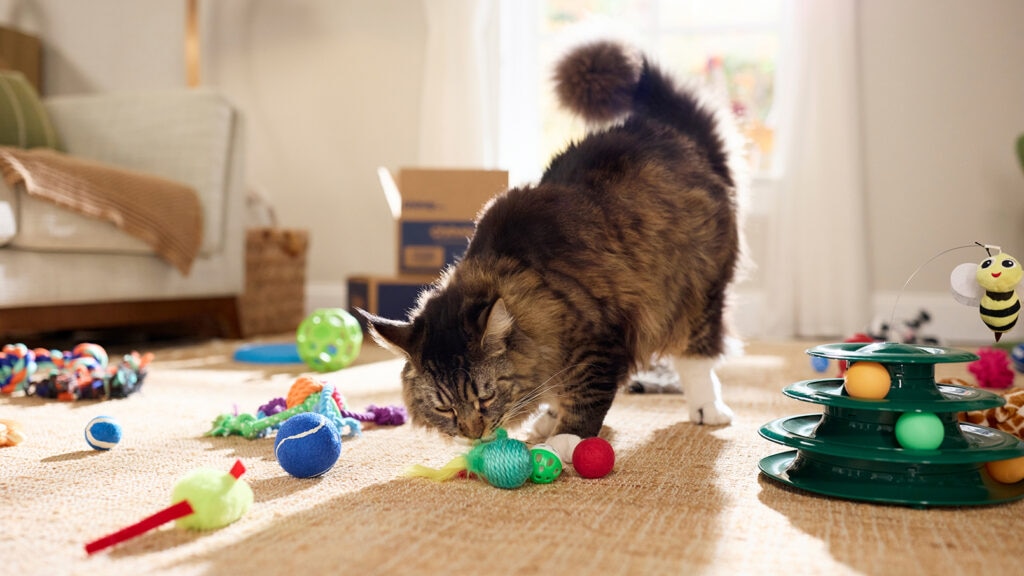
Daily play sessions support weight loss and improve a cat’s mental wellbeing.
Common Mistakes to Avoid
What not to do when helping a cat lose weight
- Never drastically reduce food intake overnight — this triggers hepatic lipidosis
- Do not switch to a “light” dry food that is still primarily grain-based
- Do not rely on exercise alone without addressing diet
- Do not use treats as meal substitutes or add them on top of full meals without adjusting the base portion
- Do not skip weighing — estimating progress by eye is unreliable in cats
- Do not expect rapid results — 3 to 4 months to lose 1 kg is normal and healthy
One of the most common mistakes is switching to a commercial “weight management” dry food without checking the ingredients. Many of these products reduce fat content but remain high in carbohydrates, which does not address the underlying dietary cause of weight gain in cats. The food type matters more than the label on the front of the bag.
Tracking Progress
Weigh your cat every two to four weeks and record the result. A cat losing weight at the correct rate should show a small, consistent reduction over time. If weight is not changing after four weeks on a reduced portion, reduce the daily amount by a further 10 percent and reassess.
As your cat loses weight, their daily calorie needs also decrease because they are carrying less mass. Recalculate the target portion every 4 to 6 weeks to keep pace with the reduction. A cat that reaches their target weight should have their portions adjusted upward slightly to maintain rather than continue losing.
If your cat is losing weight faster than 1 percent per week, increase portions slightly. If they are showing signs of lethargy, vomiting or significant appetite loss during the weight loss period, see a vet promptly.

Weigh your cat every two to four weeks and track the results to stay on target.