Wet Food vs Dry Food for Cats: Which Is Better?
The wet vs dry debate is one of the most common questions in cat nutrition, and the answer has become much clearer as research on feline health has grown. Here is what the evidence actually says.
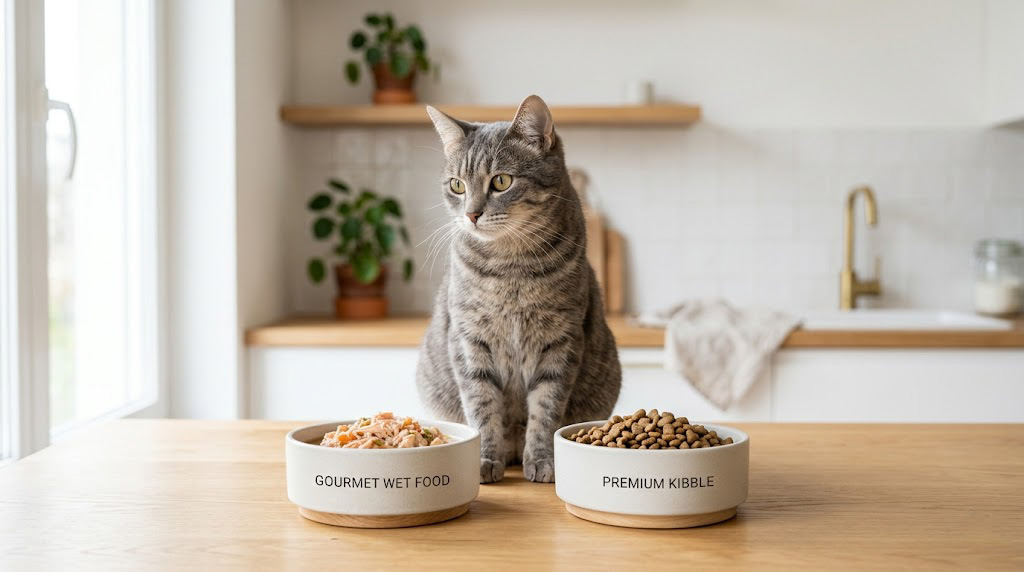
Understanding the difference between wet and dry food helps you make a better daily decision for your cat’s health.
Walk into any pet shop in Australia and the dry food aisle dwarfs the wet food section. Dry food is cheaper per serve, convenient to store and easy to leave out. These are practical advantages that have made it the default choice for millions of cat owners. The question is whether it is the right choice nutritionally, and the answer, for most cats, is that it should not be the only choice.
This guide covers the key differences between wet and dry food across hydration, protein content, carbohydrate levels and suitability for different life stages. For a broader look at what to feed your cat day to day, the Mishcats cat health guide covers nutrition and feeding routines in detail.
Wet Food vs Dry Food: Side by Side
| Factor | Wet Food | Dry Food |
|---|---|---|
| Moisture content | 70 to 82% | 6 to 12% |
| Protein from animal sources | Typically high | Variable, often lower |
| Carbohydrate content | Low (0 to 10%) | High (30 to 50%) |
| Calorie density per gram | Low (easier portion control) | High (easy to overfeed) |
| Supports urinary health | Yes, significantly | No, increases risk |
| Shelf life once opened | 24 to 48 hours refrigerated | Weeks to months |
| Cost per serve | Higher | Lower |
| Suitable as sole diet | Yes | With caveats |
The Hydration Argument
This is where wet food has the clearest advantage. Cats evolved in arid environments and developed a low thirst drive because their prey, typically small rodents and birds, provided most of their hydration. A mouse is roughly 70 percent water. Dry kibble is roughly 10 percent water. The gap between what a cat’s body expects and what dry food delivers is significant.
A cat eating dry food as their sole diet consistently consumes far less water than their kidneys require for optimal function. Over months and years, this chronic low-level dehydration is a primary driver of urinary crystals, bladder inflammation and kidney disease. These are among the most common and expensive cat health conditions seen by Australian vets, and they are disproportionately prevalent in cats fed dry-only diets.
A cat eating only dry food typically consumes 50 to 75 percent less moisture per day than a cat eating wet food as their primary diet.
Wet food solves this directly. Each serve provides meaningful hydration alongside nutrition, which means a cat does not need to drink nearly as much from a bowl to meet their daily fluid requirement. For cats that consistently underdrink, transitioning to a wet-food-primary diet is one of the most impactful changes an owner can make.

High-moisture, grain-free, 92% meat and seafood. Supports hydration with every meal.
Protein and Carbohydrates
Cats are obligate carnivores. Every essential nutrient they require, including taurine, arachidonic acid and vitamin A, must come from animal tissue. They have no nutritional requirement for carbohydrates and lack the enzyme activity to efficiently process them in large amounts.
Dry food, by its manufacturing nature, requires a binding agent to hold the kibble together. That agent is almost always starch, which means carbohydrates. Even high-quality dry foods typically contain 25 to 40 percent carbohydrate, and budget dry foods can reach 50 percent. This is not a minor difference: a cat eating a high-carbohydrate dry food is eating a diet that works against its metabolic design every single day.
Quality wet foods, by contrast, typically contain minimal carbohydrate because they do not require a binder. A high-protein wet food like those in the Feline Natural or ZIWI Peak ranges can contain less than 5 percent carbohydrate, which is far closer to what a cat would consume in a natural diet.

Quality wet food is naturally low in carbohydrates because it does not require a starch binder to hold its shape.
Where Dry Food Still Has a Role
Dry food is not without merit. There are practical scenarios where it serves a legitimate purpose in a cat’s diet, as long as it is not the only food being offered.
Convenience and storage
Dry food does not spoil once opened in the way wet food does, which makes it useful for households where precise meal timing is difficult. A small amount of quality dry food left available during the day, alongside two wet food meals, is a practical approach that many owners use successfully.
Dental surface contact
While the dental benefits of dry food are often overstated, some cats do benefit from the slight abrasive contact of chewing kibble. This is not a substitute for dental care but can be a minor contributing factor for cats that actively chew their food rather than swallowing it whole.
Cats that refuse wet food
Cats that have been fed dry food exclusively for years sometimes refuse wet food outright. In these cases, a very gradual transition over 10 to 14 days, mixing increasing amounts of wet food into the dry, is usually effective. Warming the wet food slightly to release aroma helps significantly.
Signs your cat may benefit from more wet food
- History of urinary tract infections or crystals
- Diagnosed or suspected kidney disease
- Overweight and eating primarily dry food
- Drinks very little water from a bowl
- Dull or dry coat despite a balanced diet
- Constipation or dry, hard stools
The Practical Verdict
For the majority of cats, particularly indoor cats, neutered cats and cats over 7 years, a diet built primarily on wet food is the more appropriate long-term choice. The hydration, protein quality and carbohydrate advantages are consistent and meaningful.
Dry food works well as a supplement rather than a primary food source. A combination approach using wet food as the main meal with a small amount of quality dry food available through the day gives most cats the benefits of both formats without the downsides of relying on either exclusively.
If your cat has specific health conditions that affect their dietary needs, the Mishcats vet-approved recipe library includes formulations for cats with kidney disease, food sensitivities and urinary issues, all developed by Australian Board Certified Veterinary Nutritionists.
Calculate Your Cat’s Daily Food Amount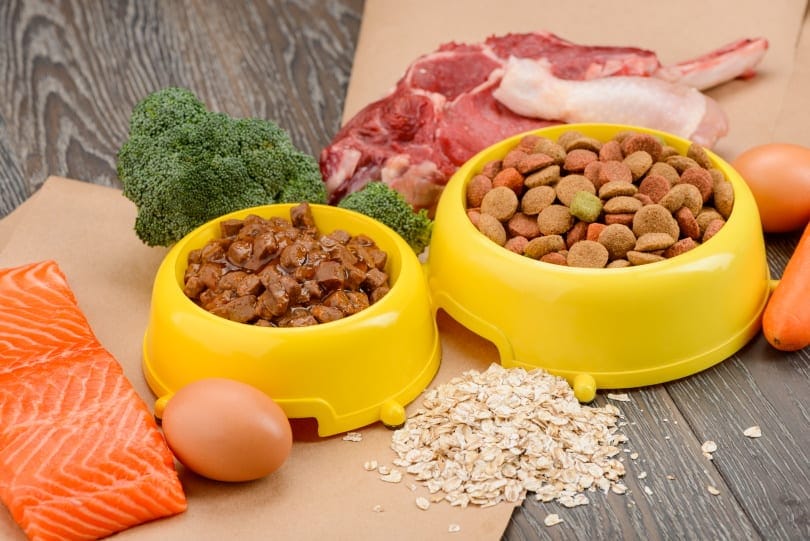
A combination of wet food meals and a small amount of dry food works well for most adult cats.